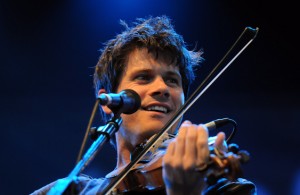
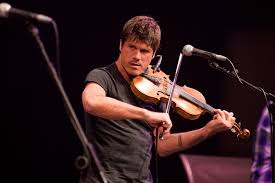
Last night provided my fizzingly excited being with one of those protracted moments which only an international music jamboree may provide. Celtic Connections invites the best of the planet’s world music into its well-lit, bustling cloisters, & it was with great delight that I, for the first time, heard Seth Lakeman play. Ten years ago, while wintering in Sicily, his album ‘Freedom Fields’ had been a constant companion, its blend of civil war ballads & sea-shanties connecting with something primeval in my British soul. The best thing to come out of Cornwall since the pastie, his songwriting is stunning, & when tangled up with brilliant musicianship & a voice through which an electric current runs with violent sincerities – a legend is truly born. People will be singing Lakeman’s songs for centuries to come, believe me, & last night I was privileged to witness him sing them on his own, stripped of his band with only a viola & guitars… plus the occasional programmed bass-drum-beat which provided a pulsing audio-stomp to proceedings.
Lakeman’s warm-up were a couple of American trad-singers, Cathy Fink & Marcy Marxer, who also happen to be wife & wife. Playing with, & loving each other, since the early 80s, they bubbled along like happy schoolgirls through an intelligent & bouyant set. The musical maestro was the motherly multi-instrumentalist Marcy Marxer, whose spell-binding fingerwork on the rarely used cello-banjo kicked off proceedings with ‘Chilly Winds.’ The main vocalist is Cathy Fink, who is no mean musican herself, & together they blend like happily married musicians should. It had been almost three decades since they’d been in Glasgow – playing at the Star Folk Club – but it felt as if they had never left, for their was an friendly easiness to their performance & crowd-cuddling antics which made them feel like friends.
The highlight for me was when they combined their ukuleles on an instrumental number called 12 Street Rag. Just like the young De Quincey had made a pilgrimage to the West Country to meet Wordsworth & Coleridge, so a young Macy caught a bus to New York & began ringing up all the Roy Clark’s in the phone book until she found the home of Ukulele master, Roy Clark. A few minutes later she was in his kitchen being taught the Rag, & as it reached my ears I felt the true lazar-beams of international cultural distillation. Also feeling in was Mr Lakeman, who was watching the performance with calm appreciation at the door at the back stood by the bouncer.
On came Mr lakeman like the God Pan with his pipes, one of the Lakeman Brothers & a part of the British folk staple for two decades – & hes still only a tender 39. His solo set flew by, a flurry of violas & guitars, of broadside ballads & disaster laments, all garnished by that curious Cornish warble of his. Lakeman enjoyed tonight, you could tell, for it gave him the chance to revisit songs skimmed over by his band over the past decade – & he delivered them perfectly. Of course as a fan of Freedom Fields, I was tearily delighted to hear The White Hare & The Colliers, but it was other songs which I’d never heard before which I enjoyed the most. Among these were a rousing number about the Tolpuddle Martyrs & another on the Penlee lifeboat disaster, showing how Lakeman is something of a ‘national bard’ of the West Country. The musicianship of one of his rare offerings was especially quality – an astonishingly seductive ballad about loveloss written 15 years ago – his harmonic pick-slapping style was pure joy to experience. Yes, I shall be seeing Mr Lakeman again, & regret not latching on to his live performances sooner. I shall be taking the wife next time!
THE MUMBLE : Hello Dr Kumaresh, & welcome to Scotland. Is this your first time?
DR KUMARESH: This is my first time performing in Scotland though I have visited Scotland as a tourist.
THE MUMBLE : Could you tell the Mumble about your specialist artform, Saraswathi Veena?
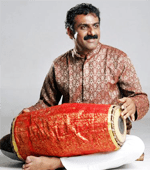
DR KUMARESH: The Saraswathi Veena is the national instrument of India and it’ll be my privilege to present it in the 70th year of India’s Independence. The history of the Saraswathi Veena runs parallel with the history of the Indian Music scene. It has been existent in different forms, sizes and shapes through the last many thousand years. The current Saraswathi Veena is a piece of art that is designed with seven strings, 24 frets and 2 resonators.
THE MUMBLE : You come from a long lineage of musicians, what is the nature of the family bond which continues the tradition?
DR KUMARESH: It is a blessing to be born in a family of musicians. I think I heard a lot of music even when I was in my mother’s womb. We were introduced to music even before we were introduced to words. Not consciously though, but the environment at home was such that somebody or the other was constantly teaching, learning, practicing or performing. These melodies reverberates within me like my voices within and made me very comfortable with the system of Indian Classical Music while I started learning it. Each generation of music in my family was exposed to a different social, economic and cultural phase of India. And each of these influences have added on from one generation to the other which is why we are traditional and yet contemporary.
THE MUMBLE : Who will you be collaborating with at your performance at Celtic Connections?
Jayachandra Rao
DR KUMARESH: Two wonderful percussionists from India are travelling with me and are going to be performing with me in both the venues. Mr. Jayachandra Rao will be performing the south Indian double headed drum called the Mridangam and Mr. Pramath Kiran will present two very characteristic instruments from the North and South of India – the Tabla and the Morching.
THE MUMBLE : The Mumble is a fan of your album, ‘Mysterious Duality,’ – will we be hearing any tracks from this in Glasgow?
DR KUMARESH: Mysterious Duality is a multi-dimensional reflection of the simple yet complex self, expressed through a single instrument, the Veena. Performed by a single artist, who uses only the Veena for the symphonic compositions, overlaying layers of several veena recordings that are based on the grammars and mathematics of India’s Carnatic classical music. The resonance of each of the many strings of seven different Veenas comes together as a harmonious whole, representing the different personas and thoughts of an individual, and the mysterious dualities of a single existential entity. Maybe I’ll perform some portions of the same.
THE MUMBLE : While in the city, will you be taking in the sights, or catching other concerts?
DR KUMARESH: I would love to explore the city and learn about the culture and history of Scotland while I’m there. I’m also hoping to catch a few other concerts at Celtic Connections.
THE MUMBLE : Finally, will you be returning to Tamil Nadu straight away, or will you be performing elsewhere in the west?
DR KUMARESH: We will be returning to Bangalore City (Karnataka) where I live. I recently completed two tours, one in England for Darbar Festival and an extensive trip to the USA in Fall of 2016.
Dr Jayanthi Kumaresh will be performing at Celtic Connections on Saturday the 28th January: Alongside the Jeremy Kittel Trio : 8PM Glasgow Concert Hall
THE MUMBLE : Hi Matthew, so you & the Dodgy boys are coming back to Scotland… where & when are you playing
MATTHEW : We are indeed, can’t wait. We’re in Edinburgh on Thursday 16th Feb at banner mans and then on to Glasgow on the Friday at the Record factory.
THE MUMBLE : What’s it like playing to a Scottish crowd & how have the Scots been with Dodgy over the years.
MATTHEW : Well because of the distance it’s always felt like a holiday and jolly up for us. Scottish folk are very funny, great drinkers and very bright, you know, soulful. Well, the ones we meet are anyway. What’s not to love about that?
THE MUMBLE : You’re promoting your new album, What Are We Fighting For? It took a while, this one, what’s the story?
MATTHEW : There’s no point going through the whole process of writing and making an album unless you believe it’s the best album you’ve ever done. We produced it ourselves and Nige mixed it, so these things take time. There’s no rush. It takes us longer to get off the sofa nowadays.
THE MUMBLE : What are the stand out tracks for you personally?
MATTHEW : I love the first track, You Give Drugs A Bad Name, it was the lead off track from the album and everyone went nuts over it, it’s immense live And I love the title track – it is so epic that that you need a base camp and your own team of sherpas to navigate it.
THE MUMBLE : What does 2017 have in store for Dodgy?
MATTHEW : Lots and lots of shows. We tried to cut back this year but we keep getting great offers through – Mallorca, a mini cruise to Rotterdam, Carfest. Loads. But lets see if we survive Scotland first.
The Oran Mor venue in the basement of a converted church performs well for both music and plays. It has a rather large standing space, luxury seating, a bar and somewhere to lean on. The Indian music I heard tonight sprang from four artists sat cross-legged in a row. Their sonic creation was pure Indian fusion that would work well for meditation of one kind or another. The singer’s voice floated effortlessly, the result of years of intense training and practice. Her lyrics were all but unknown to me, but I did find myself musing about love and loss.
The stage was then prepared in darkness for the main act, the Suns of Arqa, which was large enough to give these four musicians plenty of space between them. As the performance began to flow, they reacted to each other calmly while the dancing singer swayed her body to the music and to the lyrics. There was a darker brooding side obvious from the start, but this was not a prerequisite for the whole show at large.
What became evident quickly was how well the performers gelled and emphasised more the space and room between themselves. This connection seems to thrive through the sheer length of experience of a band who have been playing for decades, having formed in the mid-seventies. Their remarkable mix of different cultures has seen them work as intermediaries for the whole fusion scene, so important in today’s musical climate and is well on the way to becoming a world wide phenomenon.
As the show progressed, the band’s experience was brought forth more and more giving us greater and greater insight as the Connection gig progressed. Those of the audience standing were swaying, and were invited to join in singing. There was a serious side of the music and lyrics that imbued a greater respect from the audience viewpoint. And a ceremonial aspect both hinted at and demanded upon by these aspects of the shows great organisation and experimentation within the freeform of jazzy/ folk like swinging to a general sense of drum and bass music.
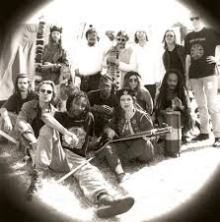
The band, with some charisma changed instruments, introducing a feeling of good quality and professionalism. Instruments ranged from bongos to age old flutes and bagpipes, while the change of singers gave another fresh aspect because the voices were completely different. The sense and mood of the performance remained constant, however, full of darker tones of which I would have liked to have read the lyrics; one to see if my interpretation were correct and two to see just how well they would enhance the general quality of the show and personal dedication of the band (on and off stage) towards the goal they had of bringing world music to the stage using both very old and very modern equipment.
It was a pleasant evening, relaxed and full of charm. A perfect scene of people quietly paying attention to the stage enjoying a drink from the bar. The music didn’t demand anything more than wanting to be heard and listened to. With clever timing, musicianship and performance.
On a day when the news was dominated by the inauguration of Donald J Trump as the President of the United States, it was a welcome relief that one day previously, Glasgow’s wonderful Celtic Connections had returned to town with ample musical talents to distract one’s mind from possible nuclear holocausts. What was even more intriguing and exciting was the deliberate inclusion of a number of strong female artists in this year’s line-up, including Olivia Newton John and Scottish Album of the Year award winner Anna Meredith. On the BBC, Celtic Connections Director Donald Shaw is reported saying “I think the festive would be worse off if it did not have a strong female presence. Gender does have a different dimension in the way it produces music.”
Tonight’s headliner Ette was certainly fulfilling the Director’s eagerness to give bright and intoxicating females the centre-stage, but more on them later. Inside Broadcast, performing to only eight people when she first appeared on stage, the humped outline of Glasgow-based songstress Chrissie Barnacle clambering over cables with her acoustic guitar was not atypical of the timid and slightly-awkward image she continually emits upon first sight. In fact, Barnacle is something special. Dreamy and pickled in wonderful insight, she finger-picks, wolf howls, and delineates her stories in a beguiling way which is instantly picked up by each newcomer into the basement. Part-fairy, part-Wiccan, Barnacle’s love-neurosis is neither mawkish nor syrupy but welcomes listeners in to a very personal account of collapsed romances and hopeful times ahead. The sublime “Cannibal Rats Part II” and “Hazelnuts” deserve special mention for such doe-eyed absorptions.
Second support for the night was ‘folk and roll’ two-piece Morrissey and Marshall. The Dublin lads were making their first visit to Scotland and were given a resounding welcome by the swollen Glasgow audience. Opening song “I’ve Got A Plan” reached Number 1 in Ireland and with a measured Beatles-influence, Darren Morrissey and Greg Marshall made a substantial impact with their opening songs, even sharing a mic at one stage during some beautiful harmonising. Songs such as “She’s Got Love” with its catchy riffs and “Pack Up Lady” were endearing stories lending their origins from back home but there were a few hit and miss efforts with Morrissey’s continuous need to mention who they were, indulge the audience in some participation, and the fact that there was a merchandise stall selling their wares at the back of the venue grating somewhat mid-set. Pick of their seven-song performance was “High And Low” which is the final track on debut album ‘And So It Began”, edging into a leisurely-Tom Meighan of Kasabian territory. A comfortable debut with minor indie filler moments and one which I am sure will only enhance their reputation.
Just prior to headliner Ette beginning their set, the audience had finally shuffled away from the seated wings of the room and huddled forward-centre whilst Franz Ferdinand’s ‘Take Me Out’ played over the sound system. The energy levels were rising and by 9.30pm, the first thing the band said was ‘Turn up the synthesizers please’, followed by ‘Amazingly, we’re not sponsored by Roland despite the stage set-up’. A 7-piece band, Ette is the solo project of Teen Canteen mainstay Carla Easton and produced by Dr Cosmos Tape Lab/Them Beatles musician Joe Kane. However, the live sets consist of a number of different musicians from various bands lending their talents – Debs Smith (Teen Canteen), Greg MacAulay (BooHooHoo), John Nicol (The Needles), Paul Kelly (The Martial Arts/How To Swim), and Chloe Philip (Teen Canteen) playing alongside Easton and Kane, deliver a sumptuous cavern of triumphant commotion. Delving into debut album ‘Homemade Lemonade’ which was released in July 2016 by Olive Grove Records, the band’s doubled-up keyboards worked formidably on opener “Bones”. Not unafraid to chat between numbers, Easton leant the personal sketches of where the songs emanated from while producer Kane’s repartee flowed in the good-natured vibe which the band exhibits. Incredibly Easton’s right-hand doesn’t cramp up during the Velvets-Waiting-For-The-Man keys on “I Hate You Song” whilst the percussion and backing vocals offered by TC team-mates Smith and Philip are invaluable during fan favourite “Attack Of The Glam Soul Cheerleaders (Part 1 & 2)”.
The key to such amiability between band members may lie in Easton’s remark that ‘the band don’t play that often’, most probably due to commitments with other projects. However, the quality takes another step up during the gorgeous “Heaven Knows”, sounding twice as good live as it does on record. Easton’s adulating lyric ‘the way you make me feel is so unreal’ sounds like something straight out of the Motown factory, while the danceable accompaniment led by Kelly’s bass dips into summer territory whereas other titles lend themselves to the winter Gods including the inspired “Fireworks” and whooshing synthetic sounds on “Bonfire”; the former of which was guided by some unorthodox knee-slapping and kazoo. Make no bones though, Easton’s vocals are shimmering throughout the set regardless which direction the music takes – a truly stimulating and refreshing voice on the UK music scene which Scotland occasionally gifts to the rest of the world. Having recently been accepted for a singer/songwriter residency at Banff Centre in Calgary, Canada it will be interesting times ahead for the Carluke girl – whether that appears in the shape of Ette, Teen Canteen, Jesus, Baby or any other projects that she chooses to delve into during 2017. However rare this evening’s performance may have been, it will not be one that they forg-ette (sorry) for a long time.
THE MUMBLE : Hi David, so where are you from originally & how did you end up in EdinburghDAVID : Hello and thanks for asking! I’m from the Highlands of Scotland originally, and lived in Glasgow too. Later, I went to Paris to be a TEFL English teacher, sucked at it, so became a segway tour guide instead. After a stint of this in Paris, and Berlin, I eventually seg’ed my way back to Scotland.
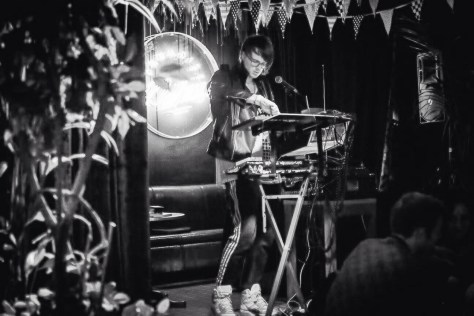
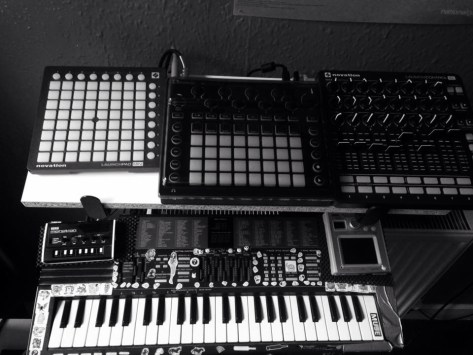
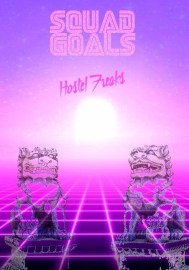
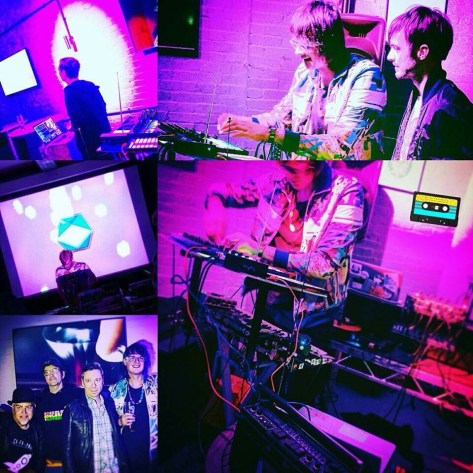
THE MUMBLE : Who, or what, are Hostel Freaks? DAVID : Hostel Freaks is mainly me playing cosmic electronica and sci-if synthwave on battered old drum machines, gadgets, & synths that are held together with duck tape (true!). If only I did all this at the same time as piloting a Segway. (Future project?) Also, because I lack the useful quality that is talent, I sometimes get friends and also my brother James to join me. He plays guitar that sounds like BB King stranded on an asteroid.
THE MUMBLE : What are the musical influences behind the band? DAVID :BB King stranded on an asteroid. Mainly that. I also quite liked that time when The Human League got lost in a huge 24hr ASDA. I think that’s when vapour-wave was invented, right?
THE MUMBLE : You have just recorded an EP – can you tell us the motivation behind it? DAVID :I got lost in the cassette and CD deptartment of Woolworths when I was a child. Luckily, The Pleasure Principle by Gary Numan was being played in full at the time over the shop speakers: I found that soothing. This EP is a re-imagining of that confusing, real life ordeal.
THE MUMBLE : Where, when & by whom was it recorded?
I wanted to record it in the freezer section of ASDA but there was too much bureaucracy involved with that (who’d have guessed?) So I settled on my living room for the location of recording. It’s got a nice rug. The rug didn’t affect the sound. But it affects the mind. Such good patterns on it. Kind of Turkish. But probably from IKEA.
THE MUMBLE : What are the plans for 2017 for Hostel Freaks
DAVID : Buy another rug. Stop getting lost in supermarkets. OH! And I’m launching the 4 track cassette EP /. Download at gigs , supported by the incredible Glamour Muscle, and Scotland’s best rapper : MC Almond Milk. You should all come!
The Mumble : Hello Victor Pope, so is that your real name or a stage persona?
Victor Pope : It’s a stage persona. It looked like my brother was going to make it big in the nineties so I thought I’d change my name so I wouldn’t be living in his shadow. The first pseudonym I had was Oliver Christ. But that seemed a little bit boastful, so I downgraded myself to the pope, and changed the first name to Victor after a nick name my old drummer used to call me. There’s always been some kind of religious theme.
***
The Mumble : Who are in the the Victor Pope Band?
Victor Pope : Me on acoustic guitar and vocals, Roy Jackson (aka Nice One Man) on mandolin, melodica, electric guitar, Swanee whistle, kazoo, xylophone and siren whistle, Jess Aslan (aka Terminator Jess) on synth, Graeme Mackay (aka Grime) on bass and Jon Harley (aka Cuddles McGee) on drums.
The Mumble : You have just released your third album, how are you feeling about the piece?
Victor Pope : I think it’s our finest work so far. We spent a lot more time on it than the other 2 albums which we tended to record live mostly in one day. On this one we recorded most things separately over the course of about 6 months. There were many obstacles in the way but we got the finished CD’s just in time for the album launch. We also produced this one entirely by ourselves, apart from the mastering which was done by Luke Woodbridge. It’s definitely in a slightly different direction than the other two albums but it’s a lot closer to the vision of the songs I have in my head.
***
The Mumble : You are one of Edinburgh’s most beloved of song-writers, your curious poetic genius winning many fans – what is the main impulse behind your songwriting
Victor Pope : Sexual frustration and death.
The Mumble : What are your favorite Cheeses
Victor Pope : Garstang red was the first blue cheese I enjoyed and from then on there was no turning back. I’m blue all the way, the smellier the better. Although I am also quite partial to a bit of Cathedral City on toast.
***
The Mumble : Edinburgh has a thriving music scene, what’s your take on it
Victor Pope : It’s a lovely place to be a musician. You get a lot of passing trade with musicians of all nationalities passing through for brief periods and leaving their imprint. It’s also very collaborative. It’s all kind of like one big hippy love in. Unlike Glasgow which seems a bit more competitive and edgy. Although you probably have to go their to make it I think I prefer the mellower vibe of Edinburgh. Edinburgh is kind of like the Hippy and Glasgow is kind of like the punk if you will. Although was it not just a couple of years ago that an Edinburgh band won the Mercury music prize? Also, a special mention has to go to Phil Ramsay and Baz Simpson who do wonders for up and coming acts in the city.
The Mumble : How does it feel to finally become a member of the Edinburgh rock aristocracy
Victor Pope : I don’t know if we’re quite there yet. But if we are I like to think we’re kind of the secret shame of the family. The deformed sibling twisted by too much inbreeding who they keep locked in the cellar and occasionally throw lumps of raw meat at. But one day, through monstrous Machiavellian machinations, he will rise to power to reek his terrible revenge. Kind of like Game of Thrones or summat.
***
The Mumble : What are the plans for Victor Pope in 2017
Victor Pope : Try and play some festivals. Try and get played on the radio. Try and work on some new material. World peace.
***
The Victor Pope Band’s latest album ‘Mental Illness isn’t Funny’ is a cracker.
The Mumble especially like ‘The Pacifist’ & ‘One of these Days.’
The shuffle culture adopted by much of the music-buying public has become so entrenched that the barriers between music genres have dissipated, leaving a polyhydric hotchpotch where anything goes but nothing remains. If the erosion of genre boundaries is so coveted by mainstream record companies, then what does this mean for the future of UK pop music – and what hazards does it present? Poet Stephen Watt investigates.
***************
Shuffle – Personal Quest
I was born a Disco Baby in the final few days of the 1970s when Earth, Wind & Fire, Chic, Donna Summer, and Sister Sledge were among the biggest selling artists ruling the radio airwaves. It is not a genre I have ever identified with although, like any true music lover, I have my favourites from that era. Since then, post-punk, indie, baggy, Britpop, trip-hop, hip-hop, jungle, trance, garage rock and grime have all been prevalent in the mainstream charts, each owning a corner of the market for anything between twelve months and three years. By the time I reached my late-twenties, the music was no longer reverberating the way that it once had. I was attending gigs where there was no great movement evident, delving into a partiality for underground electronic acts playing to semi-empty venues – Delphic, Union of Knives, Telepathe, IAMX, and RBRBR spring to mind – whilst more established acts such as Mylo and Hot Chip were successful to a degree, enjoying daytime radio coverage and occasional performances inside some of Scotland’s grander venues. However, electronica was not the dominant niche market – even when Lady Gaga was crowned Queen of Electro Pop in 2008 – with a far more generic demographic present at mainstream pop shows across the country.
***
Shuffle – Identity
Identity was paramount to Teddys, Hippies, Mods and Punk Rockers during the preceding decades but now a hybrid zeitgeist consisting of rap, rock, soul, pop, hip-hop, and dance threatened to orphan the listener from belonging to any one philosophy, culture, or movement. Fashion once spewed out masses of gig-goers adorning safety pins, flares, neon cosmetics (on men), corded trousers, parka jackets, etc. Look at a queue outside any gig across the UK and you will likely be faced with a conga-line leading from the closest Primark store to the front door of the venue, devoid of any self-expression or radical individuality. So, has the popcorn turned stale and the movie just one more remake off a worn-out conveyor belt? This may have been how it looked to the survivors of the Madchester era when Britpop arrived wherein feather-cut fans of The Seahorses and The Bluetones were the younger siblings of the bowl-cut followers of Mock Turtles and Inspiral Carpets six years previously. The haircuts were similar, the attitude was on a par, the drugs were harsher but quintessentially, hadn’t this movement already been done before?
Shuffle – Melting Pot
According to record label ‘Last Night from Glasgow’ co-founder Murray Easton, the current melting pot of styles in the contemporary music scene is considered a positive step in the right direction: “Merging pop with electro and hip-hop probably makes sense to a lot of kids, with technology allowing that to happen easily. So long as it’s done correctly and doesn’t sound rubbish”. This positive outlook is reinforced by heralded Glaswegian “Djancer” David Blair of cult pop band Colonel Mustard and the Dijon-5: “There’s a cultural revolution going on at the moment. It’s tangible, palpable and exciting being in amongst it. It’s bringing people together to share musical experiences, form community, make new friends and embrace diversity in the understanding that other music styles can be cool as well. Diversity creates acceptance and exposes division and separation for the illusion they are. The world needs more unity”.
Shuffle – Yellow Movement
It is through Blair’s band and the creation of the ‘Yellow Movement’ across Scotland that one of the most interesting coalitions of music fans have appeared over a number of years. The YM manifesto begs its supporters to “Laugh until you no longer know what it is to hate, release your soul, determine your own fate, lose your self-consciousness, find anonymous awesomeness……” and many more messages of positive, poetic reinforcement. Encouraging followers to embrace yellow garb at their gigs, Colonel Mustard, along with friends in a number of other talented Glasgow bands (The Twistettes, Girobabies, Jamie & Shoony, and Have Mercy Las Vegas) have recaptured a glimmer of what it meant to belong to one sect, albeit distancing themselves from the fanaticism attached by ardent, diehard supporters of the scenes which went before them. “The Yellow Movement transcends any specific music genre”, Blair provides – “(It is) an attempt in many ways to adopt the festival vibe of peace, love and music out of our green and pleasant land and tap into the Jungian collective unconscious in society as a whole. It is simply an idea whose time has come.
Where the seed finds fertile ground and takes root is not up to us. We are very much in the Dr Timothy Leary camp where people are asked to “think for yourselves and question authority”. It’s evident that those who it resonates with are, to go all Scottish here, sound cunts. The world needs more sound cunts. We’re talking about bringing out The Cunt EP someday. Expect the unexpected in the Dijonverse”. Blair’s testimony about the Yellow Movement takes a leaf out of Splash One’s book. In the mid-1980s, Splash happenings introduced itself in Glasgow to a number of like-minded musicians including BMX Bandits, The Pastels, Strawberry Switchblade and Orange Juice, using the aesthetics of the punk movement and giving it a highly Scottish slant. It was an affection towards discovering new sounds, styles, opinions, and sharing these visions with other bands, friends, and strangers. It was a characteristic which would last little over a year, but ultimately stamp its theory into the attitudes of Glaswegian bands for decades to come.
Enter poet and rising star Declan Welsh, a gifted young musician from East Kilbride whose recent support slots for Glasvegas and Ocean Colour Scene have rocketed the worth of his own stock. “I think that our commonality, what unites us, isn’t discussed enough. Most protest music is exactly that – it’s anti something. But the real aim, surely, is to build a world where we understand one another’s differences and come together on the basic premise that, as human beings, we need each other. That is very difficult to communicate in song without being overly sentimental, and it isn’t as cool as saying “Fuck the Tories”. Absolutely fuck the Tories, but I’m trying very hard to move into saying something on top of that. Something more constructive”.
***
Shuffle – Attitudes
With groupings and divisions now defunct, then where do music fans attach themselves and by what means? Frontman and songwriter of Dumbarton rock band The Foz Mark Joyce ripostes that “No genre exists anymore – it should be a positive trend, but sadly interesting new music makes no ripples in the mainstream now”. It’s a point – it’s a perspective. Attitudes modify in each generation. Consider the evolution of the peace-loving hippies content with love and anti-war demonstrations in comparison to the hard-edged insurrection of the punks, refusing to bow down to its overlords without at least once using their arms as a sling-shot towards oncoming riot shields and batons. The part which lyrics had to play in this transfiguration was frequently accountable for the ideologies and practises which youth culture adopted to make their point. Joyce continues “Punk is the most relevant genre with the same problems which existed in the 1970s still prevalent in this futuristic, digital age. That said, kids don’t seem to be angry anymore. Songs with a message can add so much to a composition but the current pop music market is only interested in making a quick buck”.
David Blair struttin’ his stuff
Or as Blair reminds us, “MC Dave ‘Solareye’ Hook (from Glasgow hip-hop outfit Stanley Odd) raps “Where’s the agitators?”. The KLF wrote the manual on anarchic mischief and agitation. If ‘real life’ wants to continue on its race to the bottom and turn up the absurdity, then we can shine a mirror right back on it”. Welsh advocates this opinion, renowned for his own ranting and raving which lends itself towards stalking political prey rather than a wayward, scattergun effect. “As someone who loves the specific, almost mundane detail in lyrics, I realise I’m in the minority. Most people aren’t obsessive about music so a simple, broad message gets stuck in your head. Not ambiguous like Radiohead, but just very general”. It’s a smart observation, if not a little troubling for the future of rock n’roll; revolution. Welsh continues, “There is always a place for social and political commentary. Even huge stars like Beyonce and Kendrick Lamar have elements of that to varying degrees. As always, black music leads the way in this. Especially in the current climate, people need to speak up. Art plays a huge role in winning hearts and minds and I feel we have a responsibility to say something”.
***
Shuffle – Contemporary Pop Music
Easton is also on board with this sentiment, somewhat perturbed by the direction that music classifications currently lean towards. “No genre is standing out more than any other. Music falls into two camps – good and bad”. I love a good pop tune, whether that’s Carly Rae Jepsen, Taylor Swift or my own era, Kylie Minogue – but some bands think sticking a synth on a tune means it’s pop, forgetting they need a melody and a hook (and ideally a chorus you can sing on first listen). Good pop always stands out; whether it is mainstream or alternative. However, there’s less pop to be enjoyed now – consider how few truly brilliant pop songs there were in 2016. The genre that probably stands out most is disposable music made by disposable bands/artists – the X Factor style acts” (At point of writing this, Honey G’s debut single is number 149 in the charts) As one of the exciting acts emerging from Glasgow, Welsh stands with one foot in both the pop and rock camps – blending the boundaries: “Some of our stuff is pure pop. We have a tune “Things You Do” that’s hugely inspired by Motown – the greatest pop music of all time. I think because this generation doesn’t have a movement, it means that we can understand the worth of all the different kinds of music. As much as I love punk, disco music is fucking brilliant so I think that if you care about your art, you need to be willing to take it into different directions. That entails the merging of styles”.
***
Shuffle – Record Labels, Media and Outlets
With extensive reporting that labels and employed teams of specialists seek out the appeal of intended audiences more frequently, it begs the question whether record companies guide the styles and sounds of new acts or if the artists are the ones in control these days. Easton suggests a bit of both guide the direction of the music: “Labels with their ear to the ground pick up on something unique then push it out to the wider world. Consider how the Beatles ushered in the beat explosion. Others imitate the style and sound, guiding it only so far as they can, before the labels help stretch that exposure across the world”.
It’s a point only too prevalent between the pages of music magazines who cotton on to their newest indie darlings (see The Libertines, The Arctic Monkeys, and Franz Ferdinand as cases in example over the previous decade) and then seek out a hundred further watered-down copycat acts (see Towers of London, The Kooks, and The 1990s) before ripping each of these bands from limb to limb three weeks later. Can any band survive such ruthless behaviour and retain a faithful following? “Bands/artists should never sell themselves short”, Easton asserts, “Labels will ask them to do things in terms of 360 deals seeking a cut of everything. By funding releases through shows or crowdfunding platforms like Pledge Music, artists are increasingly needed to work at their own marketing and promotion, not just focus on the song-writing aspect”. With countrywide publicity dwindling in the form of NME now effectively a free paper, does it leave the music fan unshackled to explore new inventive ways of celebrating bands and ideologies or is it having a detrimental effect on young persons, severed from the guiding hand of the music press which had led their elder siblings and parents through their formative years? Welsh is still optimistic about what music is available. “This generation belongs to hip hop, and there’s a stupid amount of amazing, weird, creative artists in that genre. I think in terms of guitar music, there’s a lot of anarchic, dark, exciting bands kicking about. Stuff like Fat White Family, And Yet It Moves, Cabbage, that kinda thing. And there is a strong social conscience behind the nihilistic front, which I really like”.
Having something tangible was key to any movement. Record stores were once considered gang huts for music lovers, but the permanent closure of stores such as Avalanche in Edinburgh or Fopp in Glasgow left many a reveller homeless, clawing online in a netherworld for new sounds and bands. Even Scotland’s biggest music festival T in the Park has succumbed to a number of issues plaguing music lovers’ need to explore and discover; potentially to the benefit of smaller bands playing at more intimate festivals across the country. Time will be the judge of whether or not this is a positive trend. To re-quote Joyce, “in this futuristic, digital age”, the advent of social media sites such as Myspace opened doors to a number of rising bands eager to share their music with the world, triggering a bedroom sanctuary which had once been hailed for its private studios of creativity but were now applied as advertising sanctums where anyone could plug their most inner thoughts and sounds. It would be unreasonable to brand this phenomenon as a damaging upshot in the story of music, but this did subsequently lead to a detached approach which continues to haunt the contemporary indie music scene. Instead of finger-walking through spines of CD cases or vinyl in stores filled with likeminded fans, there was no longer a need – the hunt was over and the choice was colossal.
***
Shuffle – The Future
So where, in essence, does that leave movements and sub-cultures? Is it wholly a generic music market where music exists only in laptops or headphones? Easton rejects this notion. “They still exist. The likes of Nightschool Records (Glasgow) are focused on discovering and releasing fantastic alternative pop music. They couldn’t care less about the charts, X Factor, and all that stuff. By releasing the likes of Happy Meals and Molly Nilsson, they have created a little movement. Clubs and certain pubs will always have a movement or sub-culture around them; DJ’s, bands, writers/bloggers, music and art fans hanging out together will always create something special. It might be a dozen people, it might be for a month, it might be for a year. But there will always be something, somewhere. You just need to look below the surface”.
That is an astute point to finish on; below the surface. Look towards Sauchiehall Street’s basement bars, Kelvingrove’s underground raves, and the Glasgow Subway transport system couriering its faithful followers to and from their homes. Music is a chameleon in a permanent form of transmutation. Its colours may not be quite as bright as they had been once before but when least expected, it will attach itself to the unlikeliest crowd of shoe-gazers or Pokemon-chasers and reveal itself.
Rich thanks to David Blair (Colonel Mustard & The Dijon-5), Mark Joyce (The Foz), Declan Welsh, and Murray Easton (Last Night from Glasgow) for their input during this piece.
Stephen Watt is the Dumbarton FC Poet-in-Residence, a crime poet, one half of gothic spoken word experimental act Neon Poltergeist, and author of the poetry collections “Spit” and “Optograms”. You can follow more of his writing on his Facebook page https://www.facebook.com/StephenWattSpit/ or his Twitter handle @StephenWattSpit.
Credit given where credit is due. Argyll and Bute seaside town Helensburgh is not an eminent presence within Scottish music folklore but the remarkable transformation of the St Columba church in the heart of the town into a modern performance space, digital education hub, exhibition room, television studio and recording suite, whilst retaining some of its most redeeming features such as the church organ, has breathed new life into the Victorian church. Add some exceptional talents travelling to the town courtesy of Café Improv curator and indie musician, Future Pilot AKA Sushil K. Dade; former member of the Soup Dragons, BMX Bandits and Telstar Ponies, and a lease of new life is stirring in the old girl.
A lengthy queue consisting of the old Glasgow indie mafia, resplendent in winter parka coats, snaked around the side of the building for the third installation of the Café Improv sessions and the arrival of Pulp frontman and radio broadcaster Jarvis Cocker. Inside, a cosy stage was assembled consisting of four lampshades, couches, fairy-lights, piano and drum-kit exuding an enchanting façade to welcome host and interviewer, BMX Bandit frontman Duglas T Stewart. Stepping aside ticket issues at the front desk for the sold-out event, the scene was set to welcome one of the leading figures from the Britpop generation.
Easy chat bounced between Stewart and Cocker, including some of the latter’s earliest memories of beginning a band, using his friends’ interest in his sister Saskia to get them onside. “The shyness I had as a child made me want to start a band as it would mean people would have to come up to me rather than the other way around”, Cocker concedes, “Hi Jarv, I’d want them to say. I really like what you did there”. That feeling of isolation continued as the Sheffield-born pop star revealed his dreams of being a spaceman in his juvenile days. “Perhaps that’s why I associated with the ‘2,000 Light Years From Home’ 7-inch single by the Rolling Stones in my mum’s collection so much – that feeling of being so far away from home was so alluring. Along with your usual comic books, I would read space annuals that were available at the time”. Encouraging the crowd to close their eyes, host Stewart played the song in its entirety to the point where it became a little uncomfortable.
While the chat was pleasant, the congenial qualities between Stewart with Cocker did appear to be somewhat homogeneous at points when discussing interest in androgyny, music, and social ineptness. Little pockets of insight to how Cocker’s interesting mind works presented themselves in an art piece called “Country Rock” by Peter Doid featuring a rainbow on a bridge which appeared on the sleeve of one of Pulp’s albums. “It appears to be some urban thing for badgers or deer, but the rainbow could be a portal to some other place. I like when you get a recognisable event but then a mythical thing happens”. Stewart agrees, offering “We both came from post-industrial, grey landscapes – you can transport yourself on a mind excursion through music”. Heavy, man! After a slight blip with music over the PA, Cocker reveals that after an accidental fall out a window sent him to hospital, he found more time to write his own thoughts down, or “bring your own details into music and bring it to life”. This point about Cocker’s writing would have been a fascinating insight into his lyricism and poetry but unfortunately the interview steered towards production by Scott Walker on Pulp’s fan-favourite “The Trees” from 2001 album ‘We Love Life’, and the opportunity had passed.
An interval signalled the end of the interview session, allowing the audience to indulge in samosas and chai tea. Whilst a snaking queue appeared to confuse itself around the venue, an unfortunate delay that could have been better spent listening to today’s guest unfurled whilst the smarter fans leapt upon the stage, keen to grab the opportunity to meet with their hero. Cocker was pleasant towards those who queued in their numbers to meet him but looked suitably ill-at-ease too, likely keen to take a break of his own. It could be easy to criticise the organisation at this point after two previous Café Improv sessions must surely have encountered similar situations, but with young girls collecting rubbish in refuse bags and friendly ushers peppered around to offer assistance wherever possible, one was quickly reminded that a number of volunteers are used to make the Digital Arts Tower, as director Brian Keating made a quick impassioned speech referring to the particular detail that the Tower hadn’t received any grants – yet. What was being achieved so far was honourable, if a little rugged around the edges in places.
In the second half, Cocker read an excerpt from Oscar Wilde’s ‘The Soul of Man Under Socialism’ in tribute to the point that Wilde had appeared at this venue in 1888 in a programme entitled ‘How to dress as a gentleman’. It was a profound acknowledgement of honest writing as Cocker quoted “Art is the most intense mode of individualism the world has ever known. Leaving guest James Yorkston to take to the stage, the capped Fifer received a warm welcome from the packed audience. Opening with “B’s Jig”, Yorkston’s romantic lyrics and in-between songs chat were perfect for a Sunday afternoon. Each miserable ode was accompanied by a hugely amusing anecdote and having only returned from India 48hrs previously, the Scottish songwriter was unsurprisingly fatigued during each performance – but with its charms. A touching dedication to his late friend and bassist Dougie Paul rounded off a 4-song set with the gorgeous “Broken Wave (A Blues For Doogie)” before apologising ‘Sorry, that was a bit….’, before trailing off. Cocker returned to the stage to perform a wonderful duet with Yorkston on a cover of folk singer Lal Watterson’s “Scarecrow” before an over-needed rendition of Pulp’s “Babies” with Cocker sharing in guitar-duties, kicking from the knee in hallmark fashion.
One further short break later & a resounding version of Pulp’s “Disco 2000” alongside house band The Poppadoms, the evening was concluded with a film-choice selected by Cocker, opting for Tim Burton’s “Batman Returns”, rounding off a fine afternoon of music, film, and food. Sometimes it can be difficult to remember that Jarvis Cocker has been involved in creating music since 1978 and one couldn’t help but feel that a wealth of fascinating anecdotes, advice, and perhaps a couple more songs would have been greatly welcomed but overall, there is stepping stones being planted by the Digital Arts Tower and Café Improv which have to be commended. If I could just get the Tower’s staff to remove a block on my phone number (Checks have been tried and tested, guys – loosen up), then I would be delighted to return and see its progression over the coming months.
Is it that time of year already? The leaves are in their first flush of Autumnal colour, like a wee brown bruise on a plum, while in the changing room at the Usher Hall, the Scottish Chamber Orchestra is slipping into its stylishly eclectic ebony uniforms, in order to sail us all through a season of classical classics. Then who better to begin with than the master himself, Amadeus Mozart. Back in 1788, the fellow spent a summer composing three of his greatest symphonies, a swansong if you will, numbers 39, 40 & 41. Unfortunately for Amadeus, war broke out in Austria, which saw Vienn’a art-lovers flee the city in fear, thus reneging on the admission fees to see Mozart’s new wok.
In fact, in his lifetime (he died in 1791), only number 40 was performed. Roll on almost 250 years, & the SCO are giving us quite a treat by playing them together. Svend Brown told the Mumble, ‘One of the marvelous hallmarks of these pieces is Mozart’s marriage of ‘learned,’ profound musical thinking with popular courtly dance tunes & the interplay of human drama that carachterises his operas at their most glorious.‘ Yes, a suitably wonderful start from the SCO for the 16-17 season.
As a spectacle, an orchestra begins with its conductor, & Robin Ticciati was on top form. A nimble-footed adonis, he kept up a vastly entertaining barrage of flicks & flows with his mercurial wand. From the jarring start of movement number one, in the 39, we were immediately flung into the marvel that is Mozart’s genius. After an half hour of supreme musicianship from the SCO – one of the warmest orchestras I’ve seen in recent years – the familiar strains of 40 filled the Usher Hall. A smooth, superlatavian ride thro’ Mozart’s muse, one could actually feel the revolutionary thought-waves that were just about to explode across Europe.
There is no whimsy in these three symphonies, no dredge or drudge, only beauty & the honey-laden sparkle of summer. Yes, Mozart captured the moment with perfect diligence, & one which was created last night with dazzling panache. Roll on net month






 The Oran Mor venue in the basement of a converted church performs well for both music and plays. It has a rather large standing space, luxury seating, a bar and somewhere to lean on. The Indian music I heard tonight sprang from four artists sat cross-legged in a row. Their sonic creation was pure Indian fusion that would work well for meditation of one kind or another. The singer’s voice floated effortlessly, the result of years of intense training and practice. Her lyrics were all but unknown to me, but I did find myself musing about love and loss.
 The band, with some charisma changed instruments, introducing a feeling of good quality and professionalism. Instruments ranged from bongos to age old flutes and bagpipes, while the change of singers gave another fresh aspect because the voices were completely different. The sense and mood of the performance remained constant, however, full of darker tones of which I would have liked to have read the lyrics; one to see if my interpretation were correct and two to see just how well they would enhance the general quality of the show and personal dedication of the band (on and off stage) towards the goal they had of bringing world music to the stage using both very old and very modern equipment.


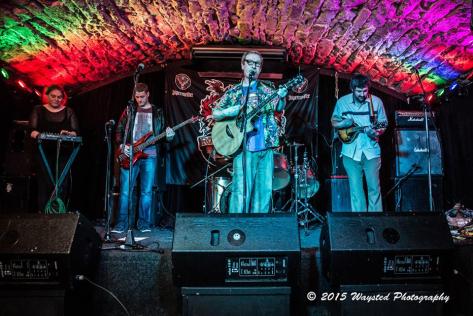



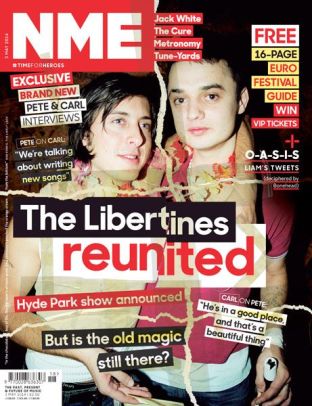 It’s a point only too prevalent between the pages of music magazines who cotton on to their newest indie darlings (see The Libertines, The Arctic Monkeys, and Franz Ferdinand as cases in example over the previous decade) and then seek out a hundred further watered-down copycat acts (see Towers of London, The Kooks, and The 1990s) before ripping each of these bands from limb to limb three weeks later. Can any band survive such ruthless behaviour and retain a faithful following? “Bands/artists should never sell themselves short”, Easton asserts, “Labels will ask them to do things in terms of 360 deals seeking a cut of everything. By funding releases through shows or crowdfunding platforms like Pledge Music, artists are increasingly needed to work at their own marketing and promotion, not just focus on the song-writing aspect”. With countrywide publicity dwindling in the form of NME now effectively a free paper, does it leave the music fan unshackled to explore new inventive ways of celebrating bands and ideologies or is it having a detrimental effect on young persons, severed from the guiding hand of the music press which had led their elder siblings and parents through their formative years? Welsh is still optimistic about what music is available. “This generation belongs to hip hop, and there’s a stupid amount of amazing, weird, creative artists in that genre. I think in terms of guitar music, there’s a lot of anarchic, dark, exciting bands kicking about. Stuff like Fat White Family, And Yet It Moves, Cabbage, that kinda thing. And there is a strong social conscience behind the nihilistic front, which I really like”.


 Mumble Music